Health & Fitness
How Did That Man Talk?
Pilate didn't have a clue who Jesus was. He lacked the imagination.

Note: These weekly blogs, based on scripture readings from the Revised Common Lectionary, are prepared as sermons for North Baptist Church, Port Chester, N.Y. The writer is a Baptist layman, a life long journalist, and a communicator for church denominational and ecumenical organizations.
I always wondered if historian Catherine Drinker Bowen fired her agent in 1970 after she was sent on a brief author-in-residence gig at Eastern Baptist College.
As an English major and student newspaper editor, I was one of the students who welcomed her to the campus.
Find out what's happening in Port Chesterwith free, real-time updates from Patch.
I could tell immediately that she had not volunteered for the honor. The expression on her face, when she realized she would be surrounded by born again Christian adolescents for two days, was the same as if she had just buried her shoe in three inches of cow pucky.
She recoiled at the perky welcome she received from grinning students who never heard of the author of Miracle at Philadelphia. When an embullient Sophomore squeezed her hand too tightly and said, “God BLESS you,” she looked as if she had been slapped. She scowled suspiciously at the chair of the English department, a Mennonite professor who wore a black plain coat that she mistook for priestly garb.
Find out what's happening in Port Chesterwith free, real-time updates from Patch.
As the English majors gathered on the rickety folding chairs that encircled her, she sat stiffly as if she were about to be grilled by the House UnAmerican Activities Committee.
The Mennonite professor read her long and impressive vita to the students, and said, “Doctor Bowen … ” (every visiting clergy or writer was doctored at Eastern in those days, because that was the highest honorific undergraduates could imagine) … “Doctor Bowen says she has no prepared remarks but she will be pleased to answer your questions.”
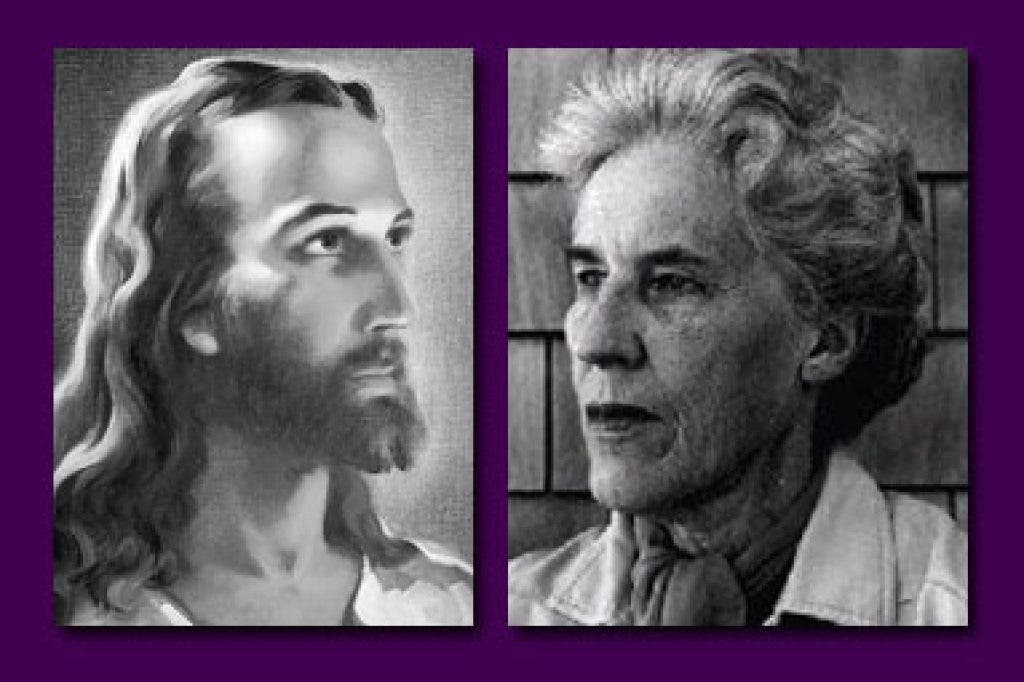
Bowen sat in her chair with her long legs tensely wrapped together like a coiled spring. She was an imposing figure with her white hair and sharp featured face, and her eyes squinted suspiciously as she waited for the first question.
There was a long, uneasy silence.
Finally, a baby-faced blond girl from Maine bounced in her chair and waved her arm at the writer. Bowen's squinty eyes got narrower.
With a misplaced sweetness familiar to those who dwell among the Born Again, the girl squealed, “Do you have a hero?”
I had heard the question often, and I knew the expected answer: “Yes! JEsus!”...
But Bowen turned her gaze inward and thought it over. Her face began to relax. Almost imperceptibly, she smiled – not a “what a sweet question” smile but a “maybe I can get through this” smile.
Bowen nodded and said, “Of course, Dear. Holmes.”
As was known by almost no one in the room, Bowen’s opus was Yankee from Olympus.
In the book, Catherine Drinker Bowen showed she had the imagination to make history come alive. Under her deft hand, Oliver Wendell Holmes is no distant, dusty judge. He becomes a living presence, capable of handing down landmark common sense to presidents.
As a young Union officer, Holmes found himself escorting President Lincoln to the barricades surrounding Washington. The six-foot-four-inch president stood up to examine the enemy lines in the distance, making him a perfect target. Holmes’ panic overcame his diplomatic judgment. He bellowed, “Get down, you damned fool!” Lincoln obediently folded his knees.
Bowen also recorded an equally brash scene in which Holmes, as a retired Supreme Court Justice, advised President Franklin D. Roosevelt – famously described by Walter Lippmann as a “pleasant fellow without any important qualification for office” – to spend more time improving his mind.
Bowen had a genius for seeking out the details that put flesh on the gray bones of history.
Slowly warming to the students, she told them an anecdote.
When she was researching Miracle at Philadelphia, her award-winning account of the Constitutional Convention, she became frustrated when sources didn’t tell her what she wanted to know.
“Such as George Washington’s voice,” she confessed. “How did it sound? No one knows. I became crazy to know how that man talked!”
Bowen, who died in November 1973, had a gift for filling that kind of historical gap. Where there is no concrete historical evidence, she said, you have to use your imagination.
The human imagination is one of God’s greatest gifts, not only because it helps us escape reality but because it helps us achieve a deeper understanding of reality. It’s one thing, for example, to know Renaissance Europeans rarely bathed. It takes a practical imagination, and a brave nose, to fancy yourself on a hot, crowded street corner in 15th century Florence.
Many of us are especially curious about history’s most significant historic event, the coming of the Messiah. The poetry of Luke, sacred art, and chancel bathrobe dramas are essential parts of the celebration, but they don’t tell us all we want to know.
What was it really like to walk the dusty roads of first-century Palestine?
What was it like when women and men began to sense the first uncertain signs that God was working a miracle in their midst?
Who was Jesus and what was he really like?
One of my favorite devotional exercises over the years is re-reading Meeting Jesus (Harper Collins, 1991), by the Rev. William P. Sampson, a Jesuit priest and former English teacher.
In this engaging book, Father Sampson offers a guide for using the imagination to encounter Jesus. Used with a modicum of creativity, these encounters can go far beyond the rewards of daily devotionals. http://amzn.to/TfpAyJ
As any casual bible reader knows, the gospel accounts leave out a lot of details about Jesus but offer tantalizing hints about his human personality. Jesus seems to have had an engaging sense of humor. He was capable of anger. He liked to eat and drink. He was a spellbinding preacher with a charisma that drew huge crowds.
But what was he like?
Did he know, every year of his life, that he was the Messiah?
What was going on inside his mind?
What would it have been like to sit beneath a cedar tree in Capernaum and talk with him?
Father Sampson, among others, has asked these questions.
Bible scholars suggest some answers but, for the most part, Sampson achieves insight by exercising his imagination.
“I do believe Jesus is God, the Son,” Sampson writes. “I do believe that he never made a sinful choice. I also believe that Jesus became aware of his divine identity before his crucifixion. He was the first to grasp the full nature of his own place as redeemer of all through his life and death.”
Using this criteria, Sampson projects “what it was like to be Jesus, what his inner experience was.”
Page by page, Meeting Jesus guides the reader’s imagination.
The book takes us on a journey through Jesus’ childhood (“As a child of Nazareth Jesus does a lot of memorizing. There is just one copy of the Scriptures in the village …”).
We witness his adult encounters with his own divinity (“Jesus knows he is at the center of a secret. Whatever is to happen and however it is to happen, he will be its centerpiece.”)
Ultimately, in our imaginations we are present at Jesus’final act of sacrifice for all.
Ray Hollenbach, in “Students of Jesus, Taking the Yoke of Discipleship,” takes these acts of imagination to another level:
At the close of William Sampson’s wonderful book, Meeting Jesus, he asks, “What was the color of Jesus’ eyes?”
The literal-minded person will immediately answer, “The Bible doesn’t tell us. We cannot know. At best we can only presume that because Jesus was born to Jewish parents blah, blah, blah.”
Sampson’s answer is more compelling: “No color is mentioned. But they were not colorless, like Little Orphan Annie. They were human eyes. And that they were human and could be looked into like any human eyes can make a big difference in getting to know Jesus.”
Can you imagine looking into the face of Jesus? Have you brought your imagination into the service of following him? In my experience too many Christians are taught to avoid subjective experiences with God.
The miracle of the incarnation is that the vast, unfathomable, unimaginable creator of the universe appears before us and invites to look into his eyes. And even more miraculous is that to know Jesus is to know God.
Granted, getting to know Jesus is an act of will, an act of yearning, as when Catherine Drinker Bowen became obsessed “to know how that man talked.”
And getting to know the true Jesus is as much an act of faith as believing in God. Even many of Jesus’ contemporaries lacked the imagination to look in Jesus’ eyes and see the truth. Pontius Pilate was as clueless after he met Jesus as before.
Then Pilate entered the headquarters again, summoned Jesus, and asked him, “Are you the King of the Jews?”
Jesus answered, “Do you ask this on your own, or did others tell you about me?”
Pilate replied, “I am not a Jew, am I? Your own nation and the chief priests have handed you over to me. What have you done?”
Jesus answered, “My kingdom is not from this world. If my kingdom were from this world, my followers would be fighting to keep me from being handed over to the Jews. But as it is, my kingdom is not from here.”
Pilate asked him, “So you are a king?” Jesus answered, “You say that I am a king. For this I was born, and for this I came into the world, to testify to the truth. Everyone who belongs to the truth listens to my voice.” (John 18:33-37)
Pilate didn’t get it and Jesus knew why: Pilate didn’t belong to the truth and he had no idea who Jesus was and where his realm existed.
But imagining Jesus can be a powerful and transforming experience for all who dare to seek the truth by wondering about the color of his eyes.
It’s not just Father Sampson’s imagination that is being enlisted in this dynamic exercise.
You, too, are invited along for the journey, and once you begin you may well find yourself engaged in an excursion of the mind that will bring you closer than ever to the mind and experience of Christ.


